
Einstein Never Took an IQ Test: 4 Facts That Bust the Myth
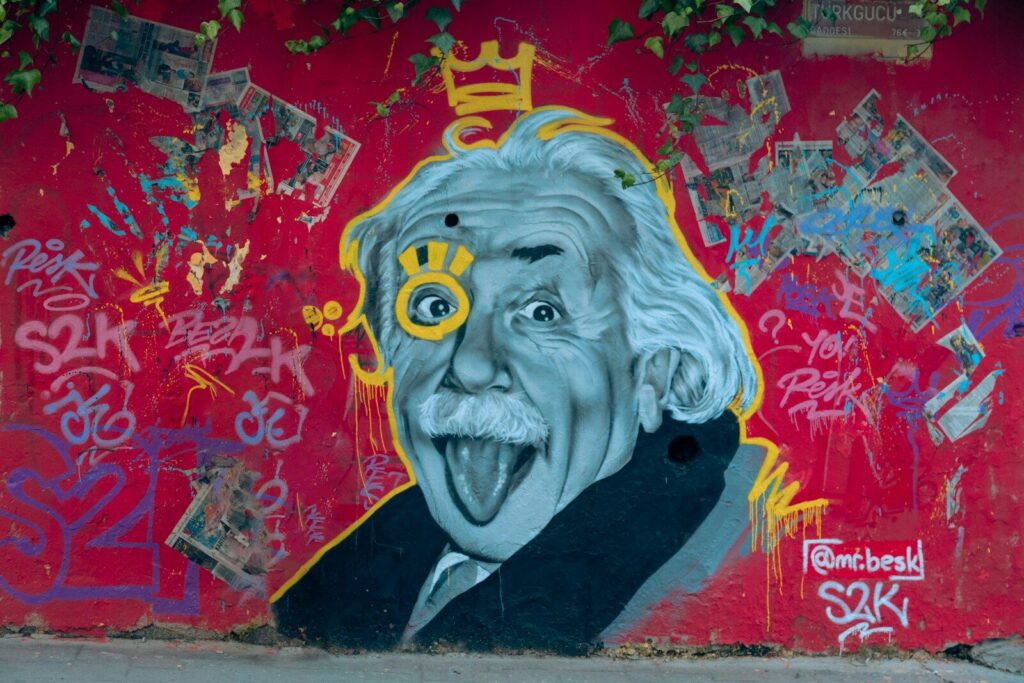
Type einstein iq score into a search box and watch what comes back.
160.
It sits at the top of list after list, calm and certain, like a height or a birthday.
You have probably quoted it yourself. Most of us have.
But the number is a story, not a score.
Einstein never took an IQ test, and the paper trail proves it in four different ways.
Each fact on its own would crack the story.
Together, they leave nothing standing.
Here are the four facts.
1) The dates rule it out
Start with the calendar, because the calendar alone ends the argument.
Einstein was born on 14 March 1879.
The first practical intelligence test did not appear until 1905.
Alfred Binet and Theodore Simon built it in Paris, and they built it for schoolchildren. Its job was to spot pupils who needed extra help in class, not to rank grown minds.
Einstein was 26 in 1905.
That same year, while working at the patent office in Bern, he published special relativity.
So the year the first test for children appeared was the same year Einstein did his most famous work.
Tests built for adults came much later.
The first widely used adult scale arrived in 1939.
Einstein was 60 by then, and world famous.
A man in that position had no reason to sit a schoolroom exam, and no schoolroom exam for adults had existed during his young years anyway.
The dates make the story impossible in the form most people tell it.
There was no adult test to take while Einstein was young.
By the time there was one, his great work was done.
2) No record exists anywhere
If Einstein had taken a test, the test would have left paper behind.
A real test leaves a trail. A test name. A date. An examiner. A score report filed somewhere.
None of those exists for Einstein.
Reporting in Smithsonian Magazine says he never took a standard IQ test.
The Einstein Archives hold no record of one.
Britannica puts it plainly. There is no evidence he ever took an IQ test.
In 2023, the psychologist Russell T. Warne went hunting for the evidence behind the famous number.
He searched the archives.
He searched the major biographies.
He found no test.
Einstein’s papers fill volume after volume. His letters fill volume after volume.
A score appears in none of them.
That silence is not a small gap in the record.
It is the whole record.
A man whose life was written down in such detail, down to his school marks and his patent office job title, left no trace of the one test the whole world says he took.
3) The 160 came from copying
So where did 160 come from, if not from a test?
Not from the serious work, that much is clear.
There was one serious attempt to put numbers on great minds of the past.
In 1926, the psychologist Catharine Cox published a study of 301 famous people.
She read their biographies and rated what they could do at each age of their youth, then turned those ratings into estimates.
Her people were born between 1450 and 1850.
Einstein was born in 1879.
He is not in her study at all.
His fame came after her cut-off, and her method could not reach him.
So 160 does not come from Cox.
It comes from popular articles, passed from list to list, each one copying the last.
Nobody in the chain shows a test, a date, or a source.
The number simply appears, neat and round, and the next writer repeats it.
Sometimes the copy grows as it travels.
Some lists say 180. Some say 205.
A measured number does not grow like that.
A rumour does.
Even Cox, whose work was careful and open about its limits, never claimed her numbers were test results.
They were estimates built from life stories, with wide room for error.
The 160 that fills a thousand web pages is not even that careful.
It is a guess, copied until the copying made it look like a fact.
4) The school myth fails too
The test myth has a twin, and the twin fails the same way.
You have heard it. Einstein failed maths at school.
His leaving certificate survives, and it says the opposite.
The certificate comes from the cantonal school at Aarau in Switzerland. It is dated 3 October 1896.
Algebra: 6. Geometry: 6. Descriptive geometry: 6. Physics: 6.
On that school’s scale, 6 was the top mark there was.
He scored 6 in history as well.
His weakest mark, for the record, was French. A 3.
So how did a row of top marks turn into a story about failure?
The scales changed under his feet.
In Germany, where Einstein started school, 1 was the top mark.
At Aarau itself, the scale flipped during his time there. His first term still used 1 as the top mark. By his final certificate, the school had switched to 6 as the top mark.
Read a row of 6s with the old German rules, and triumphs look like failures.
There is a kernel of truth buried in the legend, and it is worth digging out honestly.
In 1895, at 16, Einstein did fail an exam. It was the general part of the entrance test for the Zurich Polytechnic.
His maths and physics marks in that same exam were strong.
He failed on the language and general sections, not on maths.
Even the failure, read properly, points the other way.
What the missing test does not mean
Honesty has to cut both ways here, or it is not honesty.
No record is not the same as proof that he never sat any test of any kind.
In fact, Einstein did sit for one test we know of.
In the 1940s he completed a personality test called “Who Are You?”, built by the psychologist William H. Sheldon. It sorted people by body type, not by brains.
His completed copy is held by the Smithsonian today.
He answered it in his own way, writing yes or no instead of using the number scale the test asked for.
That is a test. It is not an IQ test, and it produced no IQ score.
And unknown does not mean low.
Everything about the work points firmly the other way.
Sit the Einstein of 1905 in front of a modern test and he would very likely have scored very high, above all on the maths and spatial parts his whole career was built on.
But “very high” is as far as the evidence honestly goes.
A test also cannot measure the thing Einstein actually did, which was to ask questions nobody had thought to ask, and then refuse to drop them for years.
Wrapping up: the myth is the story
Four facts. One answer.
The dates rule out a test in his youth. The archives hold no record of one. The 160 comes from copying, not from the one serious study of its kind. And the school record that was meant to prove he failed maths proves he topped it.
The myth survives because 160 is neat, easy to repeat, and flattering to repeat.
It turns a strange, stubborn, curious mind into a single tidy number.
The real measure is better, and it is sitting in plain sight.
Four papers from 1905, written by a 26 year old patent clerk in his spare hours, that rebuilt physics.
Page numbers. Not a score.
The next time the number pops up, ask the one question the lists never answer.
Where is the test?