
Brain Foods: 8 Things Smart People Eat for Focus and Memory
You have felt it before.
Three in the afternoon. Your eyes feel heavy. The words on the page start to swim.
So you reach for something sweet, or a third cup of coffee, and hope it wakes your brain up.
It helps for ten minutes. Then the fog comes back.
Food does feed your brain. Your brain runs on what you eat, all day, every day.
But no single food can make you smart. No food raises IQ. That is the first honest thing to say here.
Brain healthy foods are real, though. They are the foods that show up again and again in long studies of people who keep sharp memories as they age.
Here are eight of them, each with a plain note on what the proof can and cannot show.
1) Oily fish for steady fuel
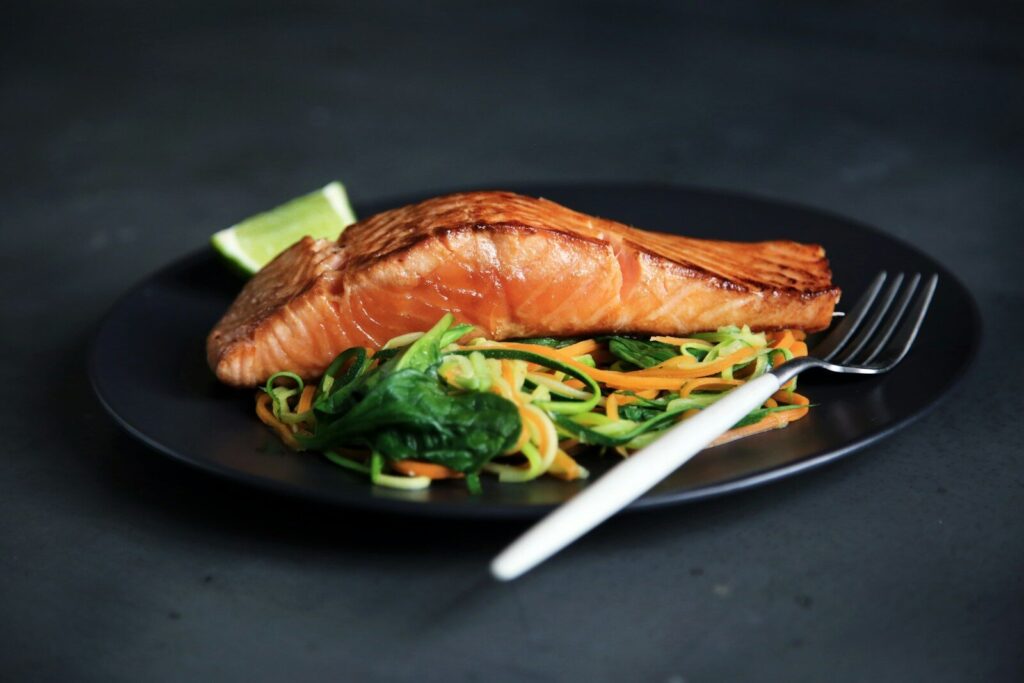
Salmon and sardines sit at the top of most brain food lists, and the reason is simple.
They are rich in DHA, a fat your brain uses to build the walls of its cells.
The link to memory comes from long studies that watch people over years.
In one pooled look at 21 such studies, with 181,580 people in all, each extra serving of fish a week was linked to about 5 percent lower risk of dementia.
That is a link, not proof. People who eat fish often eat well in other ways too.
Fish oil capsules are not the same thing. A Cochrane review of three trials found no clear help for thinking skills from the capsules.
Two servings a week is a fair aim.
A tin of sardines counts, and it costs far less than salmon.
2) Berries that stain your fingers
Blueberries and strawberries earn their place for their colour.
That deep blue and red comes from plant dyes called flavonoids, and one kind, anthocyanins, has been found in brain tissue in lab work.
The human proof is one large watching study, not a trial.
In the Nurses’ Health Study, researchers tracked 16,010 women aged 70 and over.
The women who ate the most blueberries and strawberries showed slower memory decline than the women who ate the least.
The gap was equal to about 1.5 to 2.5 years of ageing.
The women chose their own food, so other habits may have played a part.
Still, the amount was small. About half a cup of blueberries, or a cup of strawberries, a week.
3) Leafy greens in a daily handful
Spinach is the quiet star of this list. It shows one of the strongest links in this whole post.
In a study from Rush University, published in Neurology in 2018, researchers followed 960 adults with an average age of 81.
The people who ate 1 to 2 servings of leafy greens a day showed a much slower rate of decline than the people who rarely ate them.
The gap was equal to being 11 years younger in thinking skills.
One serving is about a cup of raw leaves, or half a cup cooked.
Greens carry folate, vitamin K and lutein, and those nutrients may be part of the story.
But this was a watching study too, so it cannot prove cause.
4) Walnuts, small and rich
A walnut even looks a little like a brain.
Walnuts carry plant omega-3 fats and vitamin E, and they were part of a real trial, not just a watching study.
In the PREDIMED trial in Barcelona, 447 older adults were split into three groups by chance.
One group got low-fat advice. One group got a Mediterranean diet plus olive oil. One group got a Mediterranean diet plus 30 g of mixed nuts a day.
After a median of 4.1 years, the nut group held its memory up better than the low-fat group.
That is the strongest kind of proof in this post, because people were assigned their diet by chance.
A small handful a day is the amount used in the trial. About seven walnut halves.
5) Eggs for morning focus
An egg is one of the cheapest brain foods you can buy.
The yolk holds choline, a nutrient your brain uses to make acetylcholine, a messenger that helps with memory and learning.
One large egg holds about 147 mg of choline. That is a good share of a day’s need in a single food.
The proof here is softer than the proof for fish or nuts. Higher choline intake is linked to better memory in long-term watching studies.
No trial has shown that eating more eggs, on its own, sharpens memory.
One egg with breakfast is a steady start to the day.
6) Whole grains that hold energy
Oats do not look like a brain food. They look like plain breakfast.
Their job is simple, and it matters more than it sounds.
Your brain runs on glucose, the sugar your body makes from food. It needs a steady supply, not a rush and then a crash.
Whole grains like oats give you that steady supply. They are digested slowly, so energy lasts longer.
Here is the honest limit. No trial shows that oats alone sharpen memory.
Their place on this list is as part of a pattern. People who eat whole grains most days, instead of refined grains, tend to eat in a way that is linked to slower decline.
Swap one meal a day to whole grains.
Small swap. Steady fuel.
7) Beans and lentils, cheap and steady
Beans and lentils are the cheapest food on this list, and one of the most useful.
They are rich in fibre and folate, and they give slow, steady energy, just like whole grains.
Folate helps your body keep a substance called homocysteine in check, and high homocysteine is linked to poorer thinking skills in older people.
There is no trial that tests beans alone for memory. Their place here rests on the eating pattern.
Beans and lentils show up in every eating pattern linked to slower decline, from the Mediterranean diet to the MIND diet.
Add lentils to soup, or beans to rice.
Cheap food. Steady brain.
8) Olive oil, the quiet base
Extra-virgin olive oil is not a food you eat on its own. It is the base the other foods sit on.
It was part of the same PREDIMED trial as the nuts.
In that trial, the group given a Mediterranean diet plus 1 litre of olive oil a week held its global thinking scores up better than the low-fat group, over a median of 4.1 years.
That is trial proof, and it counts for more than a watching study.
But oil is dense in calories, so a little goes a long way. One or two spoonfuls a day is plenty.
What this list does not prove
Now the caveat, because every honest list needs one.
Most of the proof in this post comes from watching studies. People who eat fish, berries and greens also tend to walk more, smoke less and sleep better.
Those habits may share the credit. The food alone may not deserve it all.
And the strongest test of the whole pattern gave a flat result.
In 2023, a trial in the New England Journal of Medicine put 604 adults aged 65 and over on the MIND diet for three years.
Their thinking scores did not improve any more than the scores of the control group. Both groups improved a little.
That does not wipe out the watching studies. It does mean the diet is not proven to protect memory.
So read this list the right way. These foods support a healthy brain as part of a healthy life.
For focus today, the basics still win. Eat regular meals. Drink water. Sleep well.
No food can stand in for a good night of sleep.
Wrapping up: start with one small swap
You do not need to buy all eight foods tomorrow.
Pick one. Just one.
Add spinach to a meal you already eat. Swap white bread for oats one morning a week. Put a tin of sardines on toast for lunch.
Your brain will simply get the steady fuel it was built to run on.
That is a small promise, and it is one this list can keep.