Albert Einstein’s 7 Rules For A Better Life

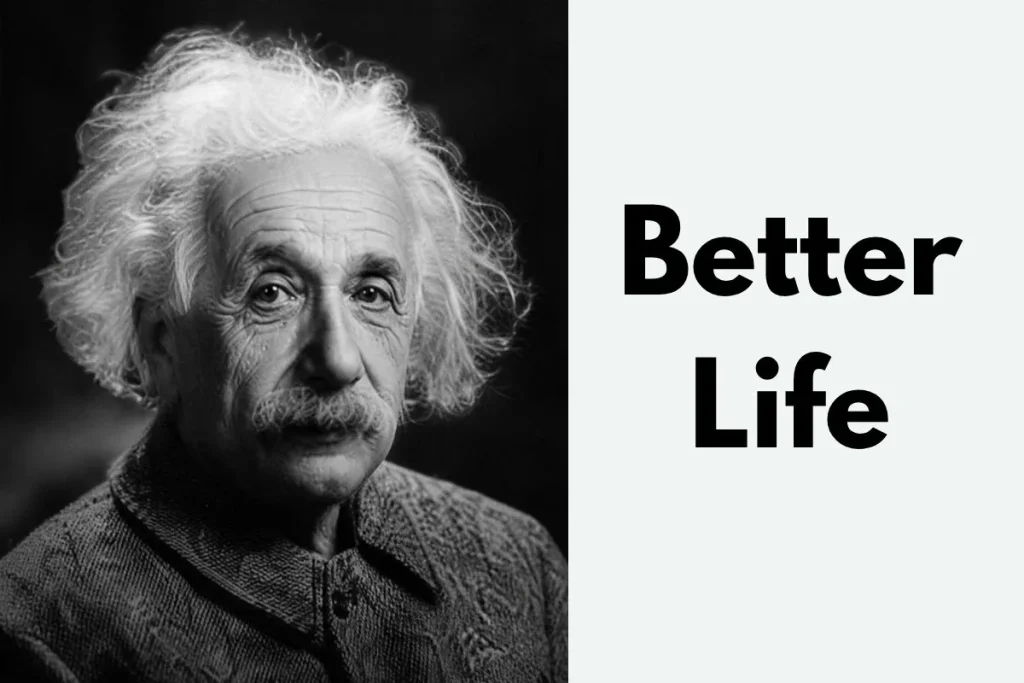
I did not grow up thinking Einstein had much to teach me about life. I knew him the way most of us do, wild hair, a chalkboard, a name we use as a joke when someone does basic math fast. It took me years, and a fair bit of my own drifting, to learn that the man who cracked give us great formula e= mc2 also left behind quiet, plain advice about how to live in it. Not equations. Just rules. Seven of them.
They did not come from a self help shelf. They came from his letters, his friends, and people who sat with him and wrote down what he said. A writer named Benyamin Cohen, who runs the official Einstein estate’s social media, pulled them together in his book The Einstein Effect. Once I read them, I could not stop thinking about how much they cut against the noise we live in now, the noise of hustle talk and life hacks and ten step plans to fix everything by Friday.
What follows is not a summary. It is me sitting with each rule, turning it over, and being honest about where it applies to my own mess. If you feel stuck, or unsure why your effort never seems to land where you want it, I think you will find yourself somewhere in here too.
Who Benyamin Cohen Is And Why These Rules Even Exist
Before I go rule by rule, it helps to know where this list actually comes from, because a lot of pages online repeat it without saying so. Cohen spent years going through Einstein’s personal letters, some to close friends, some to total strangers who wrote him out of the blue asking what to do with their lives. He noticed the same handful of ideas kept showing up. Not lectures. Just a tired, honest man trying to help someone else avoid the mistakes he had already made.
Einstein was not a tidy role model. He rarely got a haircut. He wore the same few outfits on purpose so he would not waste thought on picking clothes. He hated wearing socks. He was, by most accounts, a mediocre sailor who capsized more than once and kept going out anyway. None of that reads like advice column material. And yet it is exactly why the rules land the way they do. They were not written to sound wise. They were lived first, then noticed.
Rule One: Put Your Effort Where It Actually Matters
Einstein spent almost no energy on things he did not care about. His hair went uncombed. His clothes stayed simple. His handwriting was famously hard to read, and he never bothered to fix it. This was not laziness. It was a kind of math he did without saying it out loud, his effort was limited, so he spent it on physics, on ideas, on the questions that kept him up at night, and nowhere else.
I think about this every time I catch myself polishing something that never needed polishing. An email that could have gone out three drafts ago. A room I clean while ignoring a call I have been avoiding. We tend to spend our energy on what feels urgent instead of what actually matters, and those are rarely the same thing.
Economists call this opportunity cost, the idea that every hour spent on one thing is an hour you cannot spend on another. Einstein seemed to understand this instinctively, decades before behavioral economics gave it a name. He was not indifferent to the world. He was selective about where his attention went, which is a very different thing.
The hard part is that saying no to small things often feels rude, or lazy, or like you are letting people down. I have felt that guilt plenty of times. But every yes to something small is a quiet no to something that mattered more. Einstein just made that trade on purpose instead of by accident.
Rule Two: Do The Things You Love, Even If You Are Bad At Them
This is the rule that surprised me most. Einstein loved sailing. He was, by nearly every account from people who sailed with him, not good at it. He capsized his boat more than once. He got stuck, misjudged the wind, and probably annoyed a few dock hands along the way. He kept doing it anyway, for decades, because it gave him something that competence never could, a break from being the smartest person in the room.
We live in a culture that treats being bad at something as a reason to quit. Adults especially. Kids get a pass to be terrible at drawing or piano, but somewhere around our twenties we start believing that if we are not good at a thing quickly, it is not worth our time. I think that belief quietly robs people of joy they never let themselves have.
There is a term in psychology, the mastery trap, where people avoid activities unless they can excel at them, which slowly narrows their whole life down to a short list of things they are already good at. Einstein clearly never fell into that trap with sailing. He was not chasing mastery. He was chasing the feeling of being on the water, thinking about nothing in particular, or maybe everything at once.
I have started asking myself a small question when I avoid something new, am I avoiding this because I truly dislike it, or because I am afraid of being bad at it in front of people. Most of the time, honestly, it is the second one.
Rule Three: Treat Problems Like Puzzles, Not Crises
Einstein looked at hard problems, in physics and in life, the way a person looks at a crossword. Something to figure out, not something to fear. That distinction sounds small until you notice how differently your body reacts to a crisis versus a puzzle. A crisis tightens your chest. A puzzle makes you lean forward.
I have watched this play out in my own work more than once. The same setback, framed as a disaster, leaves me stuck for days. Framed as a puzzle, something to poke at from a different angle, it somehow becomes almost interesting. Nothing about the actual problem changed. Only the frame did.
Psychologists talk about this as reappraisal, changing how you interpret a stressful event rather than changing the event itself, and it is one of the more reliable tools for handling anxiety that shows up again and again in clinical research. Einstein was doing this long before it had a clinical name, treating relativity itself as a puzzle other physicists had circled for years without quite seeing the full shape of it.
This is not about pretending problems are small. Some are genuinely large. It is about noticing that despair rarely solves anything, while curiosity at least gives you a place to start.
Rule Four: Follow What Truly Fascinates You, Not What Looks Impressive
In 1946, a stranger wrote to Einstein asking what they should do with their life. His answer was simple and a little blunt. Find a question that interests you deeply, he said, and stay with it for years. Do not settle for easy, surface level answers just because they come quickly.
That advice cuts against almost everything career culture tells us now. We are pushed toward the fastest path, the shortest course, the credential that looks good on paper. Depth gets treated as a luxury, something you get to once the practical stuff is handled. Einstein flipped that order completely. He believed shallow, quick wins were the trap, and depth was the actual destination.
I have noticed something in myself and in people I know well, the projects that actually change something, in a career or a life, are almost never the fast ones. They are the ones you kept circling back to over years, half stubbornly, because something about them would not let go of you.
There is a real cost to chasing what looks fascinating to other people instead of what genuinely fascinates you. You end up good at things you do not care about, which is its own quiet kind of exhausting.
Rule Five: Do Not Let Politics Fill You With Rage Or Despair
Einstein lived through two world wars, fled Nazi Germany, and spent much of his later life speaking out against nuclear weapons and racism in America. He was not detached from politics. He cared, deeply, and acted on that care. But he also warned against letting political anger consume a person entirely, because rage and despair, he noticed, tend to burn out the very energy you need to actually do something useful.
This rule feels almost uncomfortable to write about now, given how loud and constant political noise has become. I am not going to pretend I always follow it. There are days the news leaves me drained before I have even had coffee. But I have started noticing the difference between being informed and being consumed, and they are not the same state at all.
Sustained outrage, research on stress physiology tells us, keeps your body in a low grade fight response for hours or days at a time, which leaves little room for the clear thinking that actual change usually requires. Einstein seemed to grasp this without needing a study to prove it. Caring does not require constant alarm. Sometimes the most useful thing you can do is calm down enough to think straight.
Rule Six: Question Authority Instead Of Obeying It Blindly
Einstein once said that blind obedience to authority is the greatest enemy of truth, and he meant it as more than a slogan. He grew up in a German school system built on rigid discipline and rote memorization, and he hated it. He credited much of his later thinking to refusing to simply accept what he was told without asking why.
This is a harder rule to live by than it sounds, because questioning authority, in a classroom, a workplace, a family, often comes with a social cost. People do not always love being asked why. I have learned, the slow and sometimes awkward way, that the discomfort of asking a question is almost always smaller than the cost of quietly going along with something that felt wrong from the start.
None of this means rejecting every rule or expert out of habit, which would be its own kind of blindness. Einstein respected evidence enormously, he simply refused to confuse evidence with authority. A claim is not true because someone powerful said it. It is true, or it is not, based on whether it holds up.
Rule Seven: Knowledge And Truth Belong To Everyone
Einstein believed science and education should never be locked behind privilege. He gave his time freely to students, to strangers who wrote him letters, to anyone curious enough to ask a real question. He turned down opportunities that would have made him richer or more comfortable if they came at the cost of shutting others out.
I find this rule quietly radical, more so the longer I sit with it. We live in a moment where information is technically everywhere and yet somehow still feels gated, behind paywalls, behind jargon built to sound smarter than it needs to be, behind gatekeeping that dresses itself up as expertise. Einstein, arguably the most respected mind of his century, chose the opposite path on purpose.
There is something worth borrowing here even at a small, personal scale. Sharing what you know, plainly, without making someone feel small for not already knowing it, costs you almost nothing and gives another person a real foothold. Einstein had every excuse to hoard his brilliance. He did the opposite, again and again, for people who could offer him nothing back.
Why These Seven Rules Still Hold Up Today
None of these rules ask you to be a genius. That is what struck me most once I stepped back and looked at all seven together. They are not about intelligence. They are about attention, where you put it, what you protect it from, and what you refuse to let steal it.
Modern psychology keeps circling back to ideas that sit close to what Einstein described. Focus as a limited resource. Curiosity as a buffer against anxiety. Depth as more rewarding than speed. He arrived at these conclusions through a messy, lived life, not a lab, which somehow makes them feel more trustworthy, not less.
How To Actually Put These Rules Into Practice
Reading a list is easy. Living by it is not, so here is how I have started applying these, in small, ordinary ways.
- Before saying yes to something small, I ask whether it pulls energy from something that matters more.
- I let myself try things I am bad at, on purpose, without needing to explain why to anyone.
- When a problem feels like a crisis, I try renaming it, even just in my head, as a puzzle.
- I protect a little time each week for the question that keeps circling back, even if it feels slow.
- I check in with how much political noise I am carrying, and step back before it turns into numbness.
- I ask why more often, even when it is a little uncomfortable to do so.
- I try to explain things plainly to people, rather than making knowledge feel exclusive.
Common Questions About Einstein’s Rules For A Better Life
Did Einstein actually write these seven rules himself as a list?
Not exactly as a numbered list. They were drawn from his letters, conversations, and recollections of people who knew him, then compiled by writer Benyamin Cohen in his book The Einstein Effect. The ideas are his, in his own words in most cases, but the tidy list format is a later summary.
What is the most important rule out of the seven?
There is no official ranking, but rule one, spending effort only on what matters, tends to resonate the most, since it quietly shapes how all the other six get applied in daily life.
Are these rules backed by anything beyond old letters?
Many of the underlying ideas line up with findings in modern psychology and behavioral economics, things like limited attention, reappraisal reducing stress, and mastery avoidance limiting joy. Einstein reached similar conclusions decades earlier, through observation rather than formal study.
Can these rules apply to someone who is not academically gifted?
Yes, and that is somewhat the point. None of the seven rules require intelligence. They ask for honesty about where your attention goes and a willingness to protect it.
Key Takeaways
- Effort spent on things that do not matter is effort stolen from things that do.
- Being bad at something is not a reason to stop doing it, if it brings you real joy.
- A problem framed as a puzzle feels different in your body than one framed as a crisis, even before anything changes.
- Depth, followed for years, tends to outperform speed chased for months.
- Constant outrage drains the exact energy needed to act clearly.
- Questioning authority is uncomfortable, but usually cheaper than quietly going along with something wrong.
- Sharing knowledge plainly costs little and gives someone else real ground to stand on.
A Final Thought
I think about Einstein less as a genius now and more as a tired, curious man who kept choosing where to put his limited energy, again and again, for most of his life. He was not perfect at it. He capsized boats. He annoyed people with his handwriting. He said things bluntly that probably could have used more softening.
He once put it simply, “The important thing is not to stop questioning.” I keep coming back to that line, not because it sounds wise on a poster, but because it is the quiet thread running through all seven rules. Question where your effort goes. Question whether being bad at something should really stop you. Question the crisis until it looks more like a puzzle. Question authority. Question whether knowledge should stay locked away.
Maybe a better life was never about having the right answers. Maybe it was always about staying willing to ask.